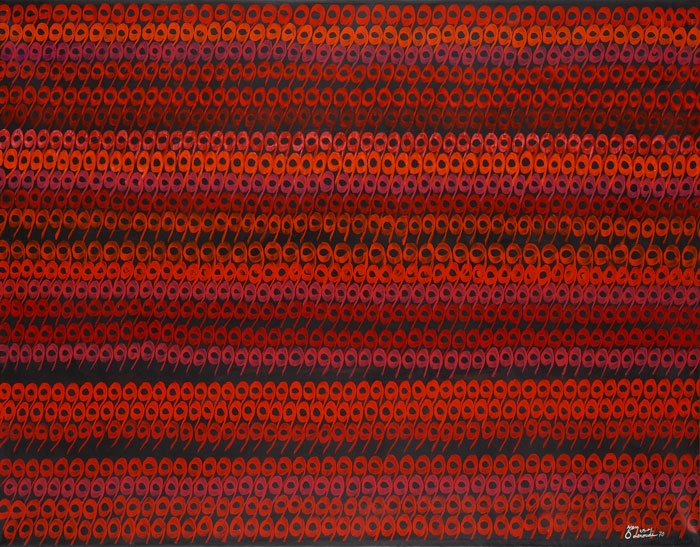
- PI + ROUZ + G 1970
- Oil on canvas
- Painting, Calligraphy Painting
- 212 * 166 cm
- Signed “Hossein” in Farsi and “Zenderoudi 70” in English (lower right)
Auction Histories
Sell at
-
Auction House
7 October 2015
Realized Price
Artwork Description
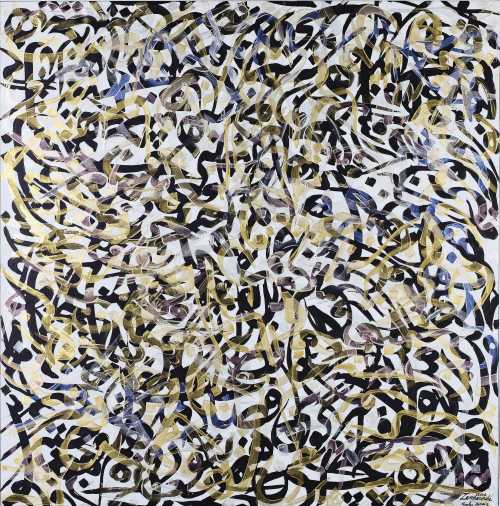
For Hossein Zenderoudi, calligraphy serves not as an end in itself but as a pretext for painting. Across the expansive surface of the canvas, letters and words are dismantled from their conventional structure and, through a process of repetition, gradually detach themselves from the realm of linguistic meaning to enter the domain of pure form. By exploiting the visual potential of the Persian script, Zenderoudi redefines the conventional appearance of letters within an entirely new visual language. His paintings require no knowledge of Persian to be experienced; instead, the viewer need only follow the fluidity of each letter, the rhythm of its strokes, the direction of its movement, and the interplay of curves and diagonals. Through the movement of the eye across the surface, the script is perceived anew—not as language to be read, but as an image unfolding in time. The repetitive rhythm of the letters opens a new horizon for language itself, one that escapes conventional semantics while remaining deeply conceptual within the discourse of contemporary art. Here, meaning is relocated from the verbal to the visual.
Zenderoudi's defamiliarization of language extends beyond separating form from meaning. He also strips the written word of its traditional geometry and sacred authority, revealing previously unexplored possibilities within indigenous artistic traditions and the enigmatic qualities of Persian calligraphy. These newly uncovered dimensions are at once lyrical and unfamiliar. By expanding the boundaries of the visual perception of letters and words, he breathes new life into the tradition of Persian calligraphy, enabling its transition from the historical realm of manuscript culture into the language of contemporary art. In this new context, script emancipates itself from the written text, relinquishes its function as writing, and acquires an autonomous pictorial identity.
In the present work, Zenderoudi repeatedly inscribes the Persian letter vāv (و) in a continuous and measured rhythm. The composition derives its vitality from the interplay of colour and the spacing between the forms. In Persian, vāv functions as the conjunction "and," connecting words and sentences. Here, however, it is repeated in an uninterrupted sequence: one vāv joins another, forming a chain of rounded shapes and oblique strokes that merge into one another before separating again, inviting the viewer's eye to retrace its path across the canvas. The letter is thus transformed from a linguistic sign into an autonomous visual form that nevertheless retains its essential association with connection and continuity—an idea communicated not through reading, but through visual perception.
Rendered in shades of orange, red, and deep crimson, the letters and signs interlace like rounded motifs woven across the canvas. Their rhythmic arrangement evokes the memory of Iranian gabbeh carpets—improvisational tribal weavings created without predetermined designs. Like the spontaneous patterns of a gabbeh, Zenderoudi's composition emerges through repetition, variation, and intuition, occupying a space between tradition and innovation, between writing and image.
Realized Price
100,120 USD
Min Estimate
60,441 USD
Max Estimate
84,266 USD
Average Artwork Worth
+63.944%
Average Growth of Artwork Worth
Sales Performance Against Estimates
Average & Median Sold Lot Value
2022 - 2026
Performance vs. Estimate
2022 - 2026
Sell-through Rate
2022 - 2026